
6 Days Kilimanjaro Climb Rongai Route
from
$1,950
6 Trekking Days + 2 Nights Hotel in Moshi
-
Reviews 0 Reviews0/5
-
Vacation Style Holiday TypeGroup Tour, Trekking
-
Activity Level Challenging
-
Group Size Small Group
All about the 6 Days Kilimanjaro Climb Rongai Route.
About Kilimanjaro Climb Marangu Route:
The Rongai route is the only route that approaches Kilimanjaro from the north, close to the Kenyan border. Though gaining popularity amongst climbers, Rongai has low traffic. It is the preferred route for those looking for an alternative to the crowded Marangu route, for those who would like a more remote hike, and for those who are climbing during the rainy season
The minimum number of days required for this route is 6 days, and seven days are recommended. Although the scenery is not as varied as the western routes, Rongai makes up for this by passing through true wilderness areas for days before joining the Marangu route at Kibo camp. This route descends down the Marangu route. Rongai is a moderately difficult route, and is highly recommended, especially for those with less backpacking experience.
-
Why Book With Us
200+ 5-star TripAdvisor reviews
Customizable tours to your preference
Personalized service by travel experts
Booking Security - Money - back guarantee
24/7 support
The tour package inclusions and exclusions at a glance
What is included in this tour?Items that are included in the cost of tour price.
- Private transport to & from Kilimanjaro International Airport to your accommodations in Moshi.
- 2 nights of accommodation in Moshi in FULL BOARD (FB). (WERUWRU RIVER LODGE OR PARK VIEW HOTEL)
- Transportation to & from the Kilimanjaro gate
- Park entry fees,
- Camping fees
- Crater fee (if any)
- Team Kilimanjaro Rescue fees
- 18% VAT on tour fees & services
- 4 Season mountain tents
- Double layered Sleeping Mats 4 inches (10cm) thick
- Friendly and professional mountain guides, cook and porters
- 3 meals daily while on the mountain
- Enough treated & filtered drinking water throughout the trek
- Hot water for washing
- Fair wages for the mountain crew as approved by the Kilimanjaro National Park Authority (KINAPA),
- Kilimanjaro Association of Tour Operators (KIATO)
- Government taxes
- Portable oxygen tanks
- Ox meter
- Emergency first-aid kit
- Stethoscope
- Portable flush toilet with a toilet and tent
- Mountain climbing certificates
What is not included in this tour?Items that are not included in the cost of tour price.
- Flights (International)
- Alcoholic and soft drinks
- Tips for safari guide
- Personal expenses in nature such as money for souvenirs, travel insurance, visa fees etc.
- Visa fees (100 USD for American and 50 USD for non-American)
- Immunization documents (yellow fever recommended for visa processing on arrivals)
- Government imposed increase of taxes and /or park fees
- Day 1 Arrive in Tanzania
- Day 2 Nalemoru Gate (1990m) to Simba Camp (2625m)
- Day 3 Simba camp (2626m) – Kikelewa Camp (3679m)
- Day 4 Kikelewa Cave (3679m) – Mawenzi Tarn camp (4303m)
- Day 5 Mawenzi Tarn camp (4303m) – Kibo hut (4730m)
- Day 6 Kibo hut (4730m) – Uhuru Peak (5895m) – Horombo hut (3705m)
- Day 7 Horombo hut (3705m) – Marangu Gate (1860m)
- Day 8 Depart Tanzania
Kilimanjaro Climb Accommodation
Where do you sleep on Kilimanjaro?
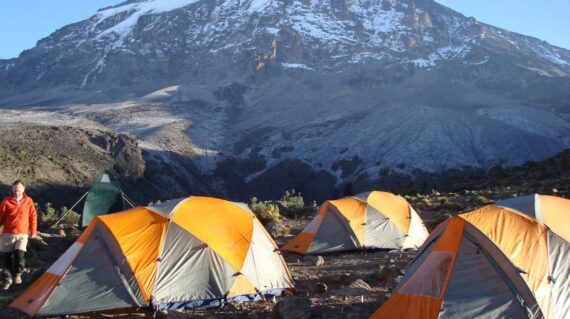
Accommodation in Kilimanjaro is Camping Unless you are on the Marangu Route, accommodation on Kilimanjaro will be in tents brought up by your porters. Do not be tempted to sleep in any of the caves, which is against park regulations.
On the Marangu Route, camping is forbidden and instead people have to sleep in huts along the route. The sleeping arrangements in these huts are usually dormitory-style, with anything from four to twenty beds per room. You will see people camping on this route, but they are trekkers who took the Rongai Route to ascend and are now descending on Marangu.
Confusingly, away from the Marangu Route many of the campsites on Kilimanjaro are actually called ‘huts’ but don’t be fooled: they are called huts because of the green shacks that you’ll find at these campsites, which are usually inhabited by the park rangers. Trekkers used to be allowed to sleep in these huts too, but no longer.
Porters and guides, however, do still sometimes sleep in them depending on the ranger’s mood and the space available.
The only other buildings you will possibly see along the trail are the toilets. Most are of the same design, namely a little wooden hut with a hole in the floor. Some are in better condition than others; all we will say is that some people are terrible shots, while other latrines are in desperate need of emptying before the contents become Kilimanjaro’s fourth peak.
The tour package inclusions and exclusions at a glance.
Marangu Huts

Camping Accommodation

You can choose your comfortable and preferred time to climb Kilimanjaro. In case of time required for the summit, you should ask for the Best Route To Climb Kilimanjaro? However, we would highly recommend you to take an 8 days or 9 days itinerary if you are a beginner and 7 – 8 days if you are a professional climber. The extra days will give you time for proper acclimatization and allow you to get adjusted to the climatic and weather conditions on the higher altitude. Hence, prefer 8 – 9 days while climbing Kilimanjaro.
Kilimanjaro is the only highest mountain which allows you to reach its summit Uhuru peak without any technical skills. Climbing Kilimanjaro is easy compared to other mountains, as it has easier terrains than steeps. However, you may need to use your hands while climbing the Barranco wall as it is the only steep wall in the entire Kilimanjaro zone. This is one of the important Kilimanjaro FAQs and has a proper answer. During wet season you may require hiking poles because the rocks are more slippery. Make sure you wear proper hiking boots or gaiters while you are climbing Kilimanjaro.
The weather in Kilimanjaro is considered as wet season and dry season. Before knowing about Best Time To Climb Kilimanjaro”, the weathers and climates are very important to decide for Climbing Mount Kilimanjaro. All the Kilimanjaro routes pass the ecological or climatic zones where the weather tends to change hourly due to the high-altitude condition and the trade winds. The wet season has more rainfall and dry season has lesser rainfall with more dry days. The main climatic zones are: Cultivation zone, Rainforest zone, Heath or moorland zone, Highland dessert zone and Artic zone. Each zone are unique in its own way and also have a distinct weather conditions all the way.
Best time to climb Kilimanjaro is a major Kilimanjaro Faq’s asked by most of the trekkers. Mount Kilimanjaro can be ascended year around and all the Kilimanjaro routes will support climbing Kilimanjaro round the year. As Kilimanjaro is near to equator the region experiences a very less extremes of winter and summer weather, rather it has wet and dry seasons. Hence, the Best Time To Climb Kilimanjaro is dry season which is warm. It is advised to avoid climbing Kilimanjaro during wet season for beginners. However, if you are with a professional climber and have all the safety precautions taken, then climbing Kilimanjaro in wet season would be really adventures. This also depends on your preference of Kilimanjaro Routes. You will need to choose best Kilimanjaro route and also choose a longer itinerary for better acclimatization.
You will be provided with tents, camping gear, food, utensils, and guidance. You should bring your own sleeping bag, water system, personal clothing, light duffle bag, and day pack. Hiking poles can be rented. If “What Do I Need To Climb Kilimanjaro?” is your question, the following list is for you. A packing list is provided to all climbers, along with our pre-departure packet:
- 1 mountaineering sleeping bag
- 1 LED flashlight with spare batteries
- 1 Pair of comfortable trekking boots
- 1 towel
- 2 fleece jackets
- 1 down jacket or long-sleeved wind-breaker
- 1 set of thermal underwear
- 2 pairs of trekking trousers
- 1 waterproof jacket
- 1 pair of waterproof trousers
- 1 sun hat
- 1 pair of sunglasses
The Kilimanjaro Food during your climb will help you to avoid from Kilimanjaro Altitude Sickness. The menu on Kilimanjaro is designed to ensure your food intake matches your level of exertion. It will provide you with a good balance of protein, carbohydrates, fruit and vegetables. When you are at altitude you could start to feel uneasy and your appetite may be suppressed, so the meals prepared at high altitude usually contain more carbohydrates and less protein to help you to digest your food.
Your meals will be prepared by your cooks on Kilimanjaro and the food will be carried by your porters. You will be provided with Porridge, Toast, Pancakes, Egg, Smoked sausages, Tea, coffee and Hot chocolate. Sandwiches, Hard boiled eggs, Biscuits, Fruit juice. Soup, Pasts, Rice, Potatoes, Chicken, Beef, vegetables, Salad and Fresh fruits.
Mount Kilimanjaro has recorded the highest altitude level and one needs to be physically and mentally fit to summit the highest peak. You will need to have good acclimatization if you are climbing Kilimanjaro. You will need to sleep on the lower elevations and spend more time on higher elevations. Climbing Mount Kilimanjaro can be an achievement as well as more than the failure. The main health issue is related to respiratory problem. You will have Kilimanjaro Altitude Sickness, Acute Mountain sickness and also it may lead to High altitude pulmonary edema and also High altitude cerebral edema. However, these are self-diagnosable at the beginning.
If you reach the severe condition you will need to descend.
Yes, it is. We encourage the parents who are looking for a good place for planning a family vacation to bring their kids in safari. There can’t be a better place for your kids to be on a vacation. Being close to nature and wildlife they can learn a lot more than reading about them in text-books. Safari vacation is safe for the children completely. We can choose child-friendly accommodations. This could mean anything from having an extraordinary pool, to gigantic rooms resting up to 4 people. We can also arrange some great activities for your children to enjoy at the lodges.
The guides and porters are professionally trained to handle the emergency situations. They are equipped with first aid kits and also trained to provide first aid medicines. In case of any severe emergency the recuse team will be available to help you descend through a stretcher or in case of more sever emergency there will be a helicopter rescue team who will take you to the high altitude medical clinic and transfer to the best hospital in the city.
It is better to check with your doctor or centre of disease control before leaving for any recommendations. This one of the major Mount Kilimanjaro Facts you should take into considerations. However, while entering Tanzania you will need a yellow fever vaccination certificate and also malaria vaccination certificate. Apart from these other vaccinations are not compulsory. However, it is better to consult your doctor for Vaccinations for Kilimanjaro if you have asthma or any chronic health problems.